
How to Use Diamond Painting Wax (Step-by-Step)
Diamond painting wax looks like a tiny accessory, but it controls one of the most important parts of the whole process: whether your pen picks up drills cleanly and releases them exactly where you want them.
When wax is loaded correctly, diamond painting feels smooth and almost rhythmic. When wax is dry, dirty, or overfilled, everything slows down. Drills fall, placement becomes uneven, and your session starts feeling frustrating.
This guide focuses on one practical goal: make your wax workflow reliable. You will learn how to load wax properly, how much to use, when to replace it, and what to do if your pen suddenly stops picking up drills.
If you need supplies while reading, here are the most relevant pages: - Diamond painting accessories - Diamond painting wax refill - Diamond painting kits
What diamond painting wax actually does
Diamond painting wax gives your pen tip a controlled level of stickiness. That stickiness needs to be balanced:
- strong enough to lift the drill
- gentle enough to release it on the canvas
- stable enough to stay consistent across many placements
If that balance is off, the symptoms appear quickly: - drills won’t lift at all - drills lift but won’t release cleanly - drills twist, tilt, or stick to the side of the pen tip
Most of these issues are not about your skill level. They are usually about wax condition and pen-tip maintenance.
Before loading wax: quick prep that saves time later
Take two minutes for setup before you load wax. It prevents most common pickup issues.
- Check your pen tip for old wax or lint.
- Keep drills clean and upright in your tray.
- Open only a small section of canvas film at a time.
- Keep fingers dry before touching tools.
- Close the wax jar whenever you pause.
If you are still getting comfortable with the basics, this helps as a companion read: diamond painting guide for beginners.
How to use diamond painting wax: step-by-step
Step 1: Remove any protective film from wax
Most wax comes with a protective layer. Remove it fully before the first load. If part of the film remains, the wax enters the tip unevenly and pickup performance drops immediately.
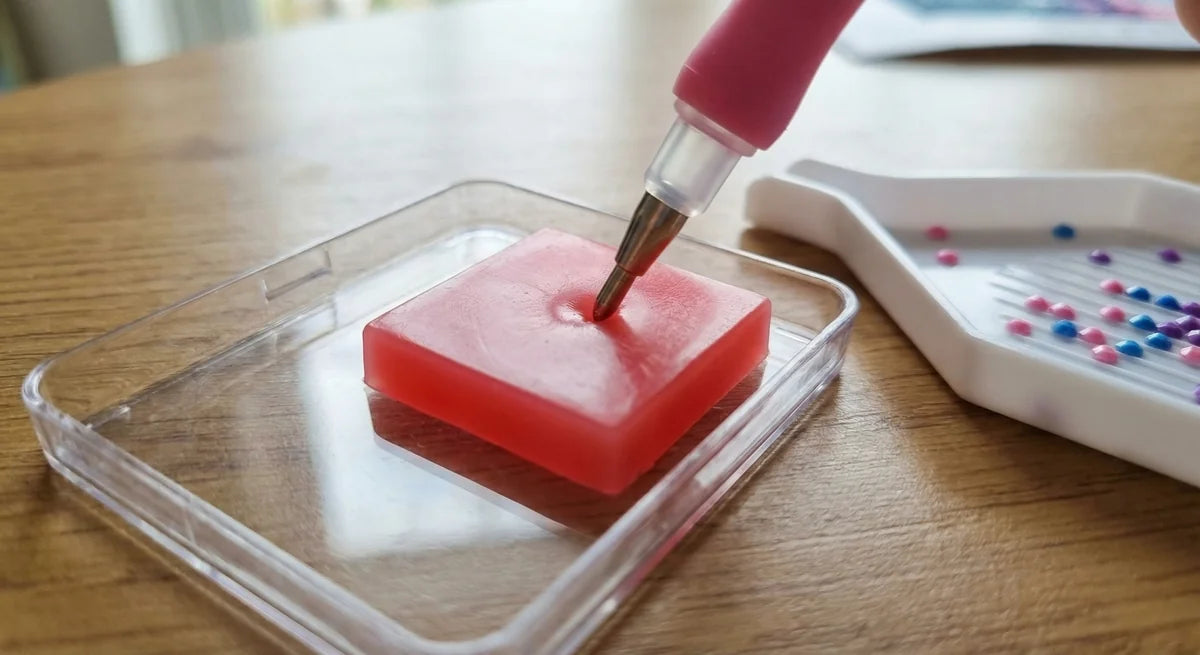
Step 2: Press the pen tip straight into the wax
Press the tip vertically, not at an angle. Use a short, firm press.

Goal: fill the cavity in the tip with a small, even amount of wax. If wax bulges out heavily, you have loaded too much.
Step 3: Test with 2–3 drills
Lift a couple of drills and place them on the canvas.
- If pickup and release both feel clean: good load.
- If drills drop immediately: add a little wax.
- If drills resist release: remove a little wax and test again.
Step 4: Re-load in small intervals
Do not wait until the pen completely fails. Re-load before performance drops sharply. Small, frequent re-loads are usually faster than big, infrequent ones.
Step 5: Replace wax when signs appear
Replace wax if you notice: - weak pickup despite correct loading - visible contamination (dust, fibres, adhesive debris) - hardened texture in the tip
Wax is a consumable part of the process. Replacing it often is normal, not wasteful.
How much wax should you use?
A common beginner mistake is overfilling the pen tip. Too much wax can make release inconsistent and cause awkward placement angles.
A better approach: - load lightly - test quickly - adjust by tiny amounts
Think of wax like calibration, not like fuel. You are tuning precision, not just “filling up”.
Why your diamond painting pen is not picking up wax or drills
Problem 1: “My pen doesn’t pick up drills anymore”
Possible causes: - wax is old or dry - tip contains mixed debris - not enough fresh wax in the cavity
Fix: 1. Remove old wax. 2. Wipe tip clean. 3. Reload with a small fresh amount. 4. Test on clean drills.
Problem 2: “It picks up drills, but won’t release them”
Possible causes: - too much wax - worn pen tip edge - too little pressure during placement
Fix: - reduce wax amount - press drill more decisively into adhesive - inspect tip for wear and replace if needed
Problem 3: “Wax gets dirty very quickly”
Possible causes: - canvas adhesive exposed for too long - dusty workspace - wax left open between placements
Fix: - reveal canvas in small sections - keep workspace cleaner and less cluttered - close wax whenever you pause
Problem 4: “Multi-placer works worse than single placer”
This is very common. Multi-placer tips need even wax distribution across the whole tip geometry.
Fix: - fill in smaller presses instead of one deep press - start with 3-placer before moving to 6–9 drills - make sure drills are aligned in your tray before pickup
How often should you change diamond painting wax?
There is no universal timer because it depends on room conditions, drill type, and your pace.
Use these practical indicators instead:
- Pickup starts failing more often.
- Wax looks grey or visibly contaminated.
- The tip feels stiff and “dead” during placement.
Some crafters re-load multiple times in one long session. That is completely normal. It usually improves flow and accuracy rather than slowing you down.
Wax use in different stages of a project
Early stage
Focus on consistency over speed. Light loads help you learn what “good pickup” feels like.
Mid stage (large colour blocks)
During repetitive sections, many people overfill to avoid re-loading. It may feel quicker for a few minutes but can reduce precision and create more correction work later.
Detail stage
For tiny symbols and edge lines, clean tip + fresh wax matters most. Old wax is most visible here because any inconsistency shows up in alignment.
Wax alternatives: do they work?
You may see people using alternatives (for example putty-like tack products). Some crafters report acceptable results, especially as a temporary option.
Still, results can vary by batch, temperature, and pen type. If you want predictable behaviour and fewer variables, purpose-made diamond painting wax is usually the safest choice.
A simple wax routine for faster, cleaner sessions
Try this practical cycle:
- keep wax, pen, and tweezers in the same fixed spot
- clean tip lightly before each re-load
- work in 30–45 minute blocks
- re-load before pickup fully degrades
This routine reduces micro-friction: small interruptions that individually feel minor but add up over a whole project.
If you want broader process improvements, pair this with: diamond painting tips and tricks.
Advanced section: using wax to improve speed and alignment
Once the basics are stable, wax management can improve both speed and straightness of rows.
A useful method:
- place drills in sets of 10–15 on one wax load
- watch for the exact moment pickup starts slowing
- re-load just before that point, not after failure
This keeps your hand rhythm smooth. Instead of sudden stop-start moments, your placement pace remains even.
For alignment, remember this: when drills consistently land slightly skewed, the cause is often uneven wax in the tip rather than poor hand control. A full tip reset (remove old wax, clean, re-load lightly) can fix line quality immediately.
Storage: keeping wax usable longer
Wax condition depends heavily on storage habits.
Good practice: - seal the container after each use - avoid direct sun and heat sources - keep open wax away from dust and fabric fibres - store spare wax closed, separate from active workspace clutter
If you work on long projects, it helps to keep one active wax container on your desk and unopened backup containers in a drawer.
When the issue is not wax
If you have reloaded and cleaned properly but still struggle, check: - drill orientation in tray - physical condition of the pen tip - canvas adhesive cleanliness in your active area
In many cases, one worn tool part creates the same symptoms as bad wax. Replacing that part can solve the issue instantly.
Final takeaway
If you want diamond painting to feel smoother every session, keep these three rules:
- Load a small, even amount of wax and test immediately.
- Replace wax early when performance drops.
- Keep tip and workspace clean.
That is the core of a reliable wax workflow.
Useful links: - Diamond painting accessories - Diamond painting wax refill - Diamond painting kits
Wax is only one part of the workspace. For the full starter setup, read about starter tools for diamond painting.
FAQ
How do I load diamond painting wax into the pen properly?
Press the tip straight into wax with a short, firm press. You want an even fill inside the tip cavity, not excess wax around the edges.
Why is my diamond painting pen not picking up drills?
Usually the wax is dry, contaminated, or too sparse. Clean the tip, add fresh wax, and test with a few drills.
How often should I replace diamond painting wax?
Replace whenever pickup performance drops, wax looks dirty, or the tip feels hard and inconsistent. Frequency varies by usage.
Can I use alternatives instead of diamond painting wax?
Some alternatives may work temporarily, but behaviour can be inconsistent. Purpose-made wax is generally more predictable.
Is multi-placer wax loading different from single placer?
Yes. Multi-placer tips need more even distribution. Use smaller, controlled presses and test before starting large sections.
