
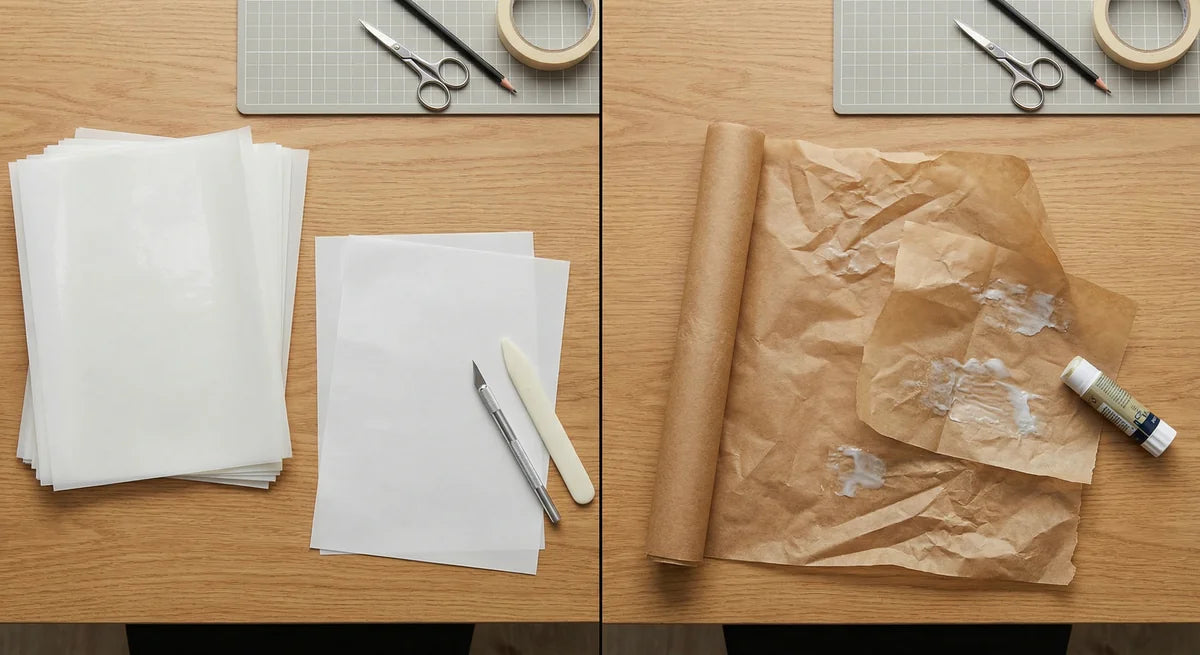
Diamond painting release paper: is it better than parchment paper?
If you want cleaner lines, fewer adhesive issues, and less frustration during a project, release paper matters more than most people think.
Many diamond painters start with the default clear cover film that comes with the kit. That is fine at first. But once you begin working in sections, storing the canvas between sessions, or doing larger projects, you quickly notice a common problem: the exposed adhesive surface picks up dust, fibres, and pet hair very easily.
That is exactly where release paper comes in.
The big question is whether you can just use baking parchment from your kitchen drawer instead.
Short answer: proper diamond painting release paper is usually the safer and more predictable option. Parchment paper may work in some cases, but quality varies and the risk is less controlled.
In this guide, you will find: - what release paper does in practical terms - release paper vs parchment vs wax paper differences - when parchment can be used (and when not to) - a section-by-section workflow to protect adhesive quality - common mistakes that can damage your canvas
What does release paper actually do?
Release paper is a protective layer that sits on top of exposed adhesive without bonding permanently to it. In simple terms, it lets you open one section, work that section, and keep the rest of the canvas protected.
A good release paper helps you: - keep glue clean while working over multiple days - split large canvases into controlled sections - reduce accidental hand contact with adhesive - prevent dust and fibres from settling on exposed glue
If you are new to the hobby, start with the core basics first in this guide: diamond painting instructions.
Release paper vs parchment paper vs wax paper
These materials are often mixed up online, which is why advice can look contradictory.
1) Diamond painting release paper
- designed for adhesive craft surfaces
- usually peels off cleanly and consistently
- sold in practical sheet sizes for section work
- behaves predictably from one sheet to the next
If your goal is low-risk, repeatable workflow, this is typically the best option. For example, a dedicated product like diamond painting release paper set (200 sheets) is made for this exact use case.
2) Parchment paper (baking paper)
- can work on some canvases
- coating and quality vary between brands
- performance can change depending on humidity and storage
- some sheets may cling too strongly over time
So parchment is not always wrong, but it is less predictable.
3) Wax paper
- generally not recommended for diamond painting
- higher chance of sticking to adhesive
- may leave residue on the glue layer
In practice, wax paper is the one to avoid.
Why release paper is usually the better long-term choice
Consistency matters on larger projects
On a small canvas, one material mistake might be manageable. On a larger project, inconsistency compounds. If one section peels cleanly and another drags or sticks, your workflow slows down and your finish quality may suffer.
Better section control
Most release paper sheets are sized for section-based work. That means less cutting, less setup time, and fewer awkward edges that expose glue.
Less decision fatigue
When every sheet behaves similarly, you do not need to re-test constantly. You can focus on drill placement and colour flow instead of material troubleshooting.
If you are upgrading your setup anyway, you can pair release paper with other essentials in the diamond painting accessories collection.
When can parchment paper still be acceptable?
There are realistic scenarios where people use parchment successfully: - your release paper ran out mid-project - you tested a silicone-coated parchment sheet and it peeled cleanly - you only need a temporary short session solution
The key principle is testing first, not guessing.
Quick patch test (2 minutes)
- Open a tiny corner of adhesive (about 2 x 2 cm).
- Place a small parchment piece on the glue.
- Press very lightly.
- Wait 30–60 seconds.
- Peel slowly at a low angle.
- Check whether glue still feels even and tacky.
If there is any resistance, residue, or uneven pull, do not use that parchment on the full canvas.
Common mistakes with release paper and adhesive covers
Mistake 1: removing the full original cover at once
This exposes too much adhesive and increases contamination risk.
Better approach: work in small sections only.
Mistake 2: peeling quickly upwards
A fast vertical pull can stress adhesive.
Better approach: peel slowly at a shallow angle.
Mistake 3: mixing unknown paper types
People often assume “paper is paper”. In adhesive crafts, material differences matter.
Better approach: use dedicated release paper whenever possible.
Mistake 4: poor storage between sessions
Even good release paper cannot fully compensate for a dusty table and open drill trays.
Better approach: store drills in closed organisers, for example diamond drill storage box, and keep your work area clean.

Step-by-step workflow: safe section method
This method works for both round and square drills.
Step 1: Plan your section size
Use practical blocks (for example 5 x 5 cm). Smaller sections give better placement control and reduce accidental hand contact.
Step 2: Cover exposed areas immediately
If you remove any original film, replace protection right away with release paper.
Step 3: Open one section only
Complete one section before opening the next. This improves accuracy and protects glue quality.
Step 4: Keep tools clean and stable
Use fresh wax and a pen that fits your pace. If your pickup is inconsistent, check your wax routine and pen tips.
Helpful tools: - diamond painting wax - diamond painting pen with metal tips - diamond painting tool set
Step 5: Seal and finish only after full placement check
Before finishing, scan for alignment and popped drills. If needed, use a roller to secure contact.
For finishing details, this guide is useful: diamond painting sealing guide.
“Parchment” naming confusion: why online advice conflicts
Some communities call baking paper “parchment”; others use “release paper” broadly, even for products that are not specifically made for adhesive craft canvases. Add regional naming differences and you get mixed advice.
Instead of relying only on labels, evaluate behaviour: - does it peel smoothly every time? - does adhesive feel unchanged after removal? - does the sheet leave any film or residue?
If the answer is uncertain, use dedicated release paper.
Best accessory combination for cleaner workflow
A simple setup that works well for most hobbyists: - release paper sheets - wax with regular refresh - stable pen + tip options - closed drill storage - optional light pad for symbol clarity
If you are comparing tool options, this article also helps with broader context: 5 most popular diamond painting accessories.
How this affects final quality
Release paper itself does not “improve art style”, but it helps preserve the conditions that produce a cleaner finish: - adhesive stays cleaner - drill placement stays more controlled - fewer interruptions from contamination fixes
That is especially useful on medium and large canvases where projects run for days or weeks.
If you also want better row precision, this comparison is helpful: round vs square drills guide.

Final recommendation
If you want the most reliable option, choose diamond painting release paper.
Parchment paper can work as a backup if you patch test first, but because quality varies by brand, it is less predictable. Wax paper is generally not recommended.
In practical terms, release paper is a small cost that often prevents larger adhesive problems later.
FAQ
Can I use parchment paper for diamond painting?
Sometimes yes, but only after a small patch test. Dedicated release paper is usually safer and more consistent.
Is wax paper the same as release paper?
No. Wax paper behaves differently and may stick to adhesive, so it is generally not recommended for diamond painting.
How many release sheets do I need per project?
It depends on canvas size and how small your working sections are. Many hobbyists use dozens of small sheets on one medium/large canvas.
Can release paper be reused?
If sheets remain clean and peel well, they can sometimes be reused. Replace any sheet that collects dust or stops performing consistently.
What should I do if paper sticks to the adhesive?
Do not pull hard. Peel very slowly at a low angle. If sticking continues, stop using that material and switch to dedicated release paper.
