
Round vs Square Drills: Diamond Painting Guide
When ordering a diamond painting kit, you'll inevitably face the question: round or square drills? This choice affects what the finished piece looks like, how quickly it's completed, and how enjoyable the process feels.
Diamond painting is a craft where you attach small plastic "drills" to an adhesive canvas. Each drill reflects light differently, creating a sparkling artwork. The drill shape determines much of the experience you'll have. Round drills are typically 2.8mm in diameter, while square drills measure 2.5mm – a small difference that affects how they fit on the canvas.
In this guide, we'll cover the strengths and weaknesses of both options – whether you're a beginner or an experienced crafter.
Round Drills: Easy and Fast
Round drills are the most common type in diamond painting. Their popularity comes from one simple reason: they're easy to use.
Pros
Placing a round drill on the canvas is straightforward. The drill doesn't need to be at an exact angle because the round shape looks good regardless of its orientation. This makes the work faster and more relaxed.
Because placement is easier, even large projects get completed in reasonable time. Round drills pick up easily with the pen and release cleanly from the tray – the workflow is smooth and requires no special technique.

Cons
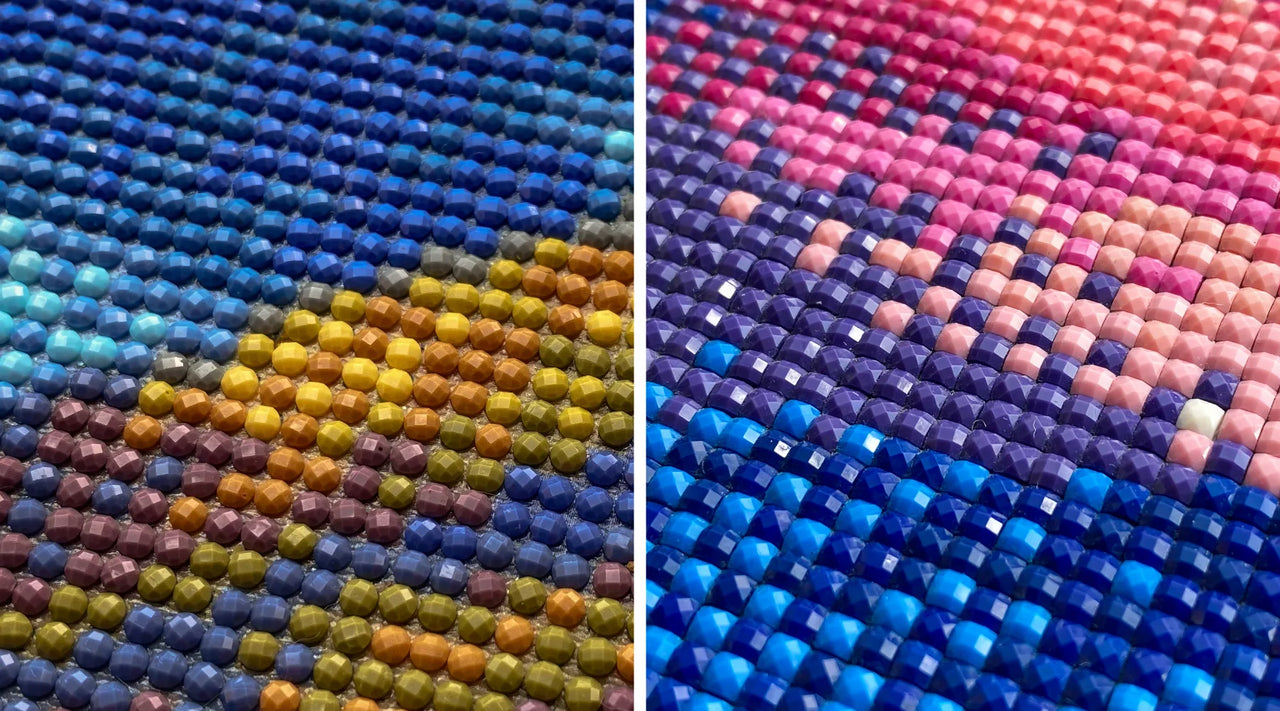
There's always a small gap between round drills because circles don't fit perfectly together. The adhesive canvas shows slightly in the finished work. From a distance, you barely notice it, but up close, the surface isn't completely uniform.
Who are they for?
Round drills are ideal for beginners and those who value speed and a relaxed crafting experience.
Square Drills: A Seamless Finish
Square drills are more demanding than round ones, but they reward patient crafters with a stunning result. They fit on the canvas like mosaic tiles – tightly together without gaps.

Pros
The biggest advantage of square drills is the polished appearance. The drills cover the canvas completely, and the finished work looks seamless – almost like a printed image that sparkles.
Many experienced crafters prefer square drills because the result feels more complete and refined. If you plan to frame your work or give it as a gift, square drills make an impression.
Square drills also produce a satisfying "click" sound when they snap into place – a small detail that many crafters consider one of the best parts of the hobby.
Cons
Placing square drills requires more precision. Each drill needs to be straight, or the rows start to skew. This makes the work slower.
Mistakes are also harder to fix. If you notice a crooked row after ten drills, you'll need to remove them and start over.
Who are they for?
Square drills suit advanced crafters and perfectionists who value precision and a polished finish.
Comparison: Round vs Square Drills
| Feature | Round Drills | Square Drills |
|---|---|---|
| Drill size | 2.8mm | 2.5mm |
| Difficulty | Easy | Medium–challenging |
| Placement speed | Fast | Slower |
| Precision required | Low | High |
| Appearance | Good, small gaps | Seamless, mosaic-like |
| Recommended for | Beginners | Advanced |
| Fixing mistakes | Easy | More difficult |
Which one is for you?
If you're just starting out, choose round drills. You'll learn the technique quickly and see results. Your first project doesn't need to be perfect – it needs to be fun.
If you've completed a few projects and want a challenge, try square drills. The first square drill project may feel slow, but the technique develops quickly.
Many crafters use both depending on the situation: round drills for relaxed evening crafting, squares when you want to invest in the result.
Project size also matters. For large pieces, round drills save significant time. For smaller, detailed works, squares bring out the fine details better.
Summary
Round drills offer an easy and fast experience, while square drills reward you with a polished finish. The best way to find your favourite is to try both.
Choose the drill that feels right for you – and enjoy every single placement.
Browse our Diamond Painting collection →
Need more drills? Check out our Diamond Painting drills or see all Diamond Painting supplies.
