
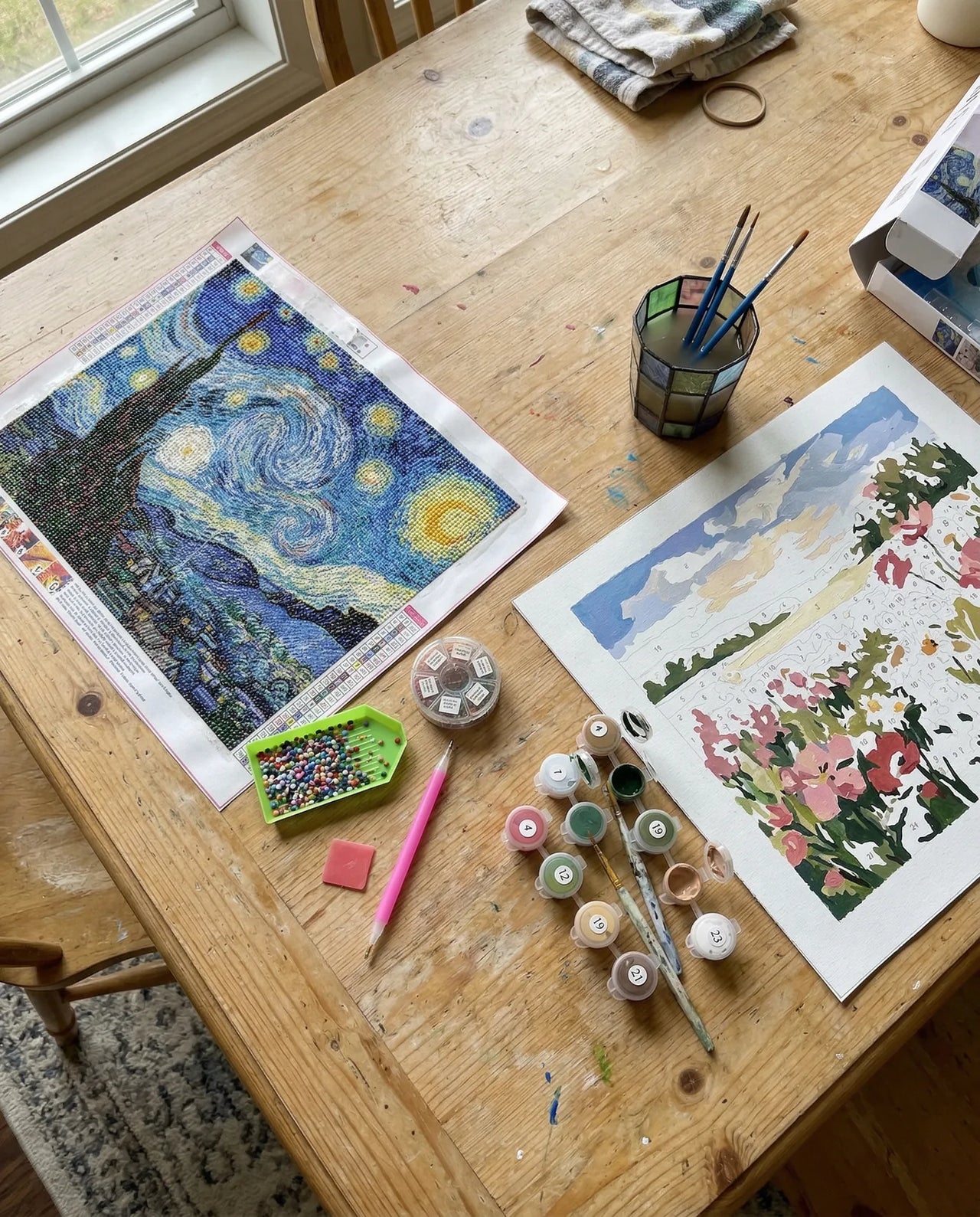
Diamond Painting vs Paint by Numbers – Which Should You Try?
Choose paint by numbers if you want to work with a brush and paint; choose diamond painting if you prefer placing small drills onto a symbol-coded canvas. The most useful comparison is the making process and the finish you want, rather than which hobby is supposedly easier or better.
The Core Difference in One Sentence
Diamond painting builds an image by placing drills onto an adhesive canvas. Paint by numbers builds it by filling numbered areas with the matching paint. In both, the pattern guides you; the hands-on task is different.
Side-by-Side Comparison
Technique and Process
In diamond painting, you match a symbol to its drill colour, pick up drills with an applicator and position them on the canvas. The working rhythm centres on placement, alignment and keeping colours organised.
In paint by numbers, you match the canvas numbers to the paint pots, choose a brush that fits the area and fill the shapes. You manage paint on the brush, work around wet sections and clean the brush between colours.
Choose by the task you enjoy: placing individual pieces or spreading paint with a brush. Neither requires you to draw the underlying picture yourself.
Difficulty and Learning Curve
For either craft, inspect the actual design rather than judging difficulty from the hobby name. Look at the smallest areas, how clearly you can identify them and how often the colours change. A detailed small canvas is not automatically an easier first project than a larger, clearer design.
Diamond painting asks you to place and align small pieces. Paint by numbers asks you to control a brush within printed boundaries and check paint coverage. If one of those tasks appeals to you more, that is a useful starting point for choosing your first kit.
Time Commitment
The same canvas dimensions do not mean the same workload. Detail, colour changes and your own working pace all affect the time you spend. Paint by numbers also involves brush cleaning and allowing painted areas to dry.
Before buying, think about where you can leave the project between sessions and how much time you want to give it. Once started, note how long a small representative section takes. Use that as a rough planning guide for similar sections, allowing extra time for more detailed areas and finishing. Do not treat a size-based estimate as a deadline.
Finished Look and Aesthetics
Diamond painting has a raised, mosaic-like surface made from individual drills. Paint by numbers has a painted surface, where brushwork and paint coverage contribute to the finish. Decide whether you would rather display a drill-based image that catches the light or a painted canvas.
Compare the complete design as well as its close-up detail. The subject, colours and composition matter just as much as the technique; neither craft has to fit one particular decorating style.

Illustration of mosaic-style and painted surfaces.
Mess and Practicality
For diamond painting, make room for the canvas, tray and drill containers. Keep opened colours separate, close the containers and cover the unfinished area when you stop.
For paint by numbers, allow space for paint pots, rinse water, a cloth and the canvas. Protect the work surface and leave room for the painting to dry without being disturbed.
If you want to move the project between rooms or take it away with you, check the actual canvas size, storage arrangement and available work surface. Choose a setup you can pack away and use on a stable surface.
Price
Compare the particular kits you are considering, including the selected size, contents, delivery and any frame or accessories you want. There is no useful fixed price winner between the two hobbies: a small ready-designed kit and a large custom-photo kit are different purchases.
Check what is included before adding extras. Plan for the tools and display method you will actually use rather than buying a complete accessory collection at the outset.
Custom from Your Photo — Which Works Better?
Start with the finish you want: an image built from drills or one you paint with a brush. Then consider how the main subject will fit on the chosen canvas. Neither technique can promise to preserve every small detail in every photograph.
For a portrait or pet photo, check whether the face and eyes occupy enough of the image. For a group photo, consider the room each person will have after cropping. A busy background can compete with the detail you most want to keep.
Our photo-selection guide for custom paint by numbers explains cropping, lighting and the review before production. For a drill-based picture, the custom diamond painting photo and size guide explains how to compare image detail and canvas size, with a route to the editor preview.
Choose the medium first, then assess the photo: a preference for sparkle or paint is more useful than assuming that one craft is always for detail and the other only for atmosphere.
Comparison Table
| What to compare | Diamond Painting | Paint by Numbers |
|---|---|---|
| Main action | Place drills onto the matching symbols | Paint the matching numbered areas |
| Skills you practise | Placement, alignment and colour organisation | Brush control, coverage and painting around boundaries |
| Working space | Canvas, tray and organised drill containers | Canvas, paint pots, rinse water and a protected surface |
| Between sessions | Cover the unfinished area and close drill containers | Close paint pots, clean brushes and leave wet areas undisturbed |
| Finish | Raised, drill-based mosaic | Painted canvas with brushwork |
| Workload | Compare detail and colour changes, not just dimensions | Compare area size and detail; allow for cleaning and drying |
| A photo of your own | Choose size and crop for the subjects you want to show | Choose size and crop for the subjects you want to paint |
| Budget | Check the actual kit, delivery and chosen extras | Check the actual kit, delivery and chosen extras |
Who Should Choose What — Quick Guide
- You enjoy arranging small pieces: consider diamond painting and choose a design whose detail appeals to you.
- You want to use paint and a brush: consider paint by numbers, with areas that suit the level of precision you want to practise.
- You have limited working space: measure the canvas and plan storage before choosing either kit.
- You are buying a gift: match the recipient's preferred activity and subject, then consider the project's scale. Neither hobby is automatically the better gift.
- You have a meaningful photograph: choose the finish you prefer and use the relevant photo guide before deciding on size.
Frequently Asked Questions
Which is easier for a complete beginner?
Compare the design and the task. Diamond painting involves positioning small drills; paint by numbers involves controlling a brush inside numbered areas. A clear design and a manageable project are more useful starting points than assuming one hobby is easier for everyone.
Which produces a better-looking result?
Choose by the finish you prefer. Diamond painting creates a drill-based mosaic, while paint by numbers creates a painted surface. Compare the subject and composition too, rather than choosing solely by technique.
Can I do both?
Yes. You do not need to commit to one hobby. Start with the activity you most want to try and consider the other when you want a different making process.
What accessories do I need beyond the kit?
Check the specific kit's contents first, then plan your work surface, lighting and storage. A frame or finishing product is a separate choice, not an automatic first purchase. If you are considering a coating for a diamond painting, our guide helps you decide whether to seal the finished work.
Which is cheaper?
Compare the complete cost of the two kits you actually want, including delivery and selected extras. Their dimensions, contents and custom options matter more than a general price comparison between hobbies.
Where to Start
To build a picture drill by drill, browse our diamond painting kits. For a project using paint and a brush, browse our paint by numbers kits.
Before starting your chosen craft, follow the diamond painting beginner instructions or the paint by numbers beginner guide. Choose a picture you want to make and a working process you want to spend time on.
