
Wooden Puzzles for Adults – A Guide to This Creative Hobby
There's a moment — usually about twenty minutes into your first wooden puzzle — when you realise you've been holding your breath. Not from stress, but from concentration. Your phone has been silent on the other side of the room. The tea has gone cold. And you don't care, because you've just found the tiny fox-shaped piece that slots perfectly into the corner of a forest scene. That click of wood against wood is oddly satisfying in a way that cardboard never quite manages.
If you've been curious about wooden puzzles for adults but weren't sure what the fuss is about, this guide covers everything: what makes them different, how to choose your first one, and why so many people across Europe are quietly swapping their screens for a table full of beautifully cut wooden pieces.
What Makes Wooden Puzzles Different?
If you've only ever done cardboard jigsaw puzzles, wooden ones feel like a different hobby entirely. The material changes everything — the weight, the sound, the durability, and the overall experience.
The feel of real wood
Cardboard puzzle pieces are thin, light, and slightly floppy. They bend at the corners after a couple of uses, the surface fades, and humidity warps them. Wooden pieces are 4–5mm thick, precisely laser-cut, and satisfyingly heavy in your hand. They click into place with a firm, decisive snap rather than the soft squish of cardboard.
This isn't just an aesthetic upgrade. The thickness means pieces stay put on the table — no accidental bumps sending half your work to the floor. And a finished wooden puzzle holds together so tightly you can lift it without glue.
Whimsy pieces: the hidden surprise
The real magic of wooden puzzles lies in what enthusiasts call "whimsy pieces" — specially shaped pieces cut into recognisable silhouettes. Instead of the standard four-tab-and-socket shape, you'll find pieces shaped like animals, trees, stars, or symbols that relate to the puzzle's theme.
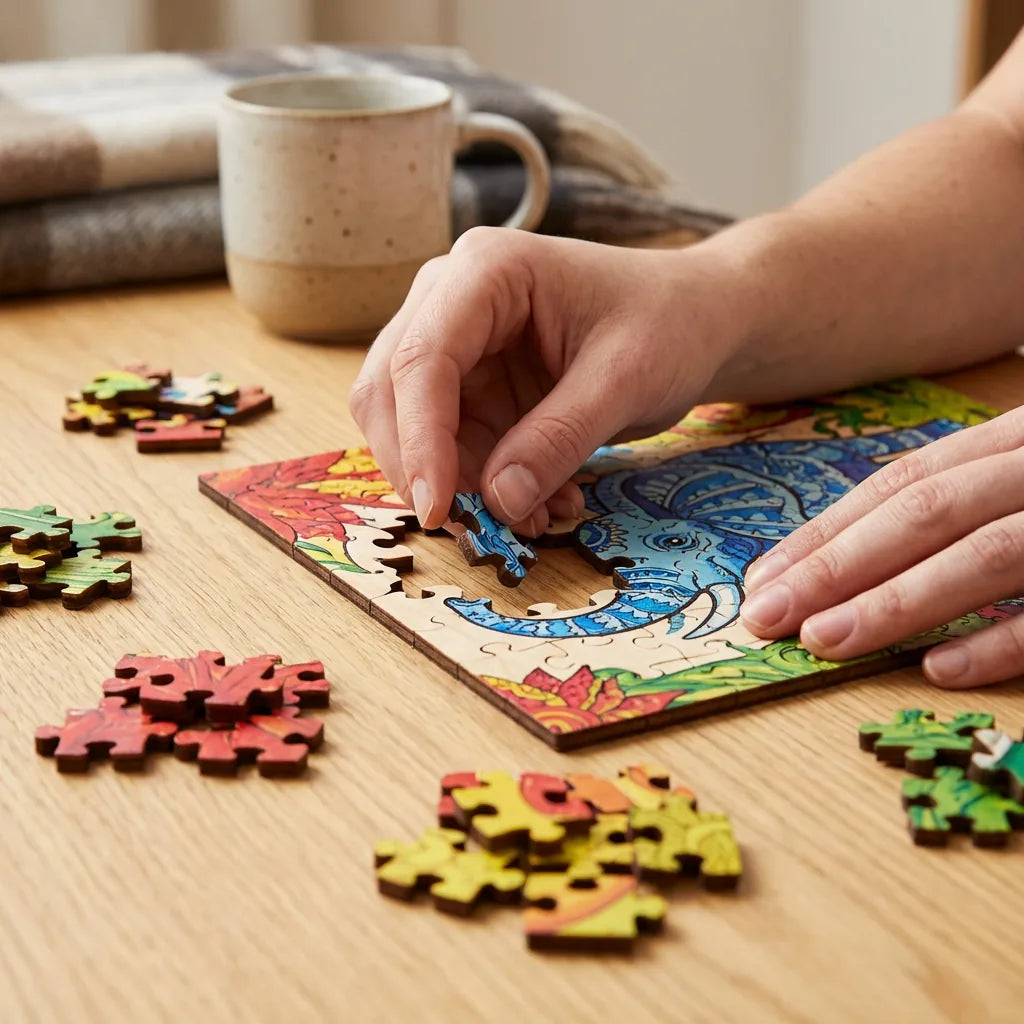
An elephant-themed puzzle might contain tiny elephant-shaped pieces hidden throughout. A tiger design could include pawprint silhouettes and jungle foliage outlines. Discovering these whimsy pieces as you assemble is genuinely delightful — each one is a small surprise that makes the process far more engaging than standard puzzles.
Most quality wooden puzzles dedicate 20–30% of their pieces to whimsy shapes. That means in a 132-piece puzzle, you might find 30 or more uniquely shaped pieces. They also serve a practical purpose: their distinctive shapes make them easier to identify and place, giving you anchor points to build around.
Why Wooden Puzzles Are Having a Moment
Wooden jigsaw puzzles aren't new — they were actually the original form of puzzle, invented in the 1760s by London mapmaker John Spilsbury. But they're experiencing a remarkable resurgence across Europe, particularly among adults in their 30s to 60s. Here's why.
The screen fatigue factor
Many adults now spend upwards of eight or nine hours a day looking at screens. Work, social media, streaming, messaging — it adds up relentlessly. Wooden puzzles offer something increasingly rare: a hobby that's completely analogue. No notifications, no algorithms, no blue light.
Many people describe puzzling as a form of digital detox — a way to give their eyes and minds a proper break without just... sitting there doing nothing. Your hands stay busy, your brain stays engaged, but in a calm, focused way rather than the scattered attention that screens demand.
Flow state on demand
Psychologists talk about "flow" — that state of deep concentration where time seems to disappear and you're fully absorbed in what you're doing. It's the same feeling musicians get when playing or runners experience mid-run. Puzzles are remarkably good at inducing flow because they require just the right balance of challenge and skill.
You're constantly making micro-decisions (does this shape fit? Is that colour right?), getting immediate feedback (satisfying click or gentle rejection), and working toward a visible goal. Your brain engages both logical and visual processing simultaneously. It's mentally stimulating without being stressful — a rare combination.

Solo or social — it works both ways
One of the lovely things about wooden puzzles is their flexibility. They're perfect for a quiet evening alone, but equally enjoyable as a social activity. Couples use them as screen-free together-time. Families gather around them after dinner. Friends bring them to cabin weekends.
There's no competition, no score, no timer. Just the shared pleasure of spotting a piece someone else has been searching for, or the collective satisfaction when a tricky section finally comes together.
How to Choose Your First Wooden Puzzle
If you're new to wooden puzzles, the variety can be overwhelming. Here's what actually matters when choosing.
Piece count = difficulty level
The general guide:
- Under 100 pieces — Quick and relaxing. Ideal for a first try or a busy weeknight. Typically done in 30–60 minutes.
- 100–200 pieces — The sweet spot for most adults. Challenging enough to be satisfying, manageable enough to finish in one or two sittings. The 132-piece animal puzzles at paintbynumbers.fi fall right in this range — complex enough to hold your attention for a good couple of hours.
- 300–500+ pieces — For experienced puzzlers. These are weekend projects or ongoing table-toppers that stay in progress for days.
Starting with the 100–200 range gives you the best introduction. You'll experience the full joy of whimsy pieces and the satisfaction of completion without the commitment of a multi-day project.
Theme matters more than you'd think
You'll be staring at this image for hours, so choose something you genuinely enjoy looking at. Popular themes include:
- Animals — The most popular category, and for good reason. Animal puzzles tend to have the most creative whimsy pieces (an elephant puzzle with elephant-shaped pieces, a lion with mane-shaped silhouettes, a turtle with shell-patterned cuts).
- Landscapes — Mountains, forests, ocean scenes. Beautiful but often more challenging due to large areas of similar colour.
- Art reproductions — Classic paintings reimagined as wooden puzzles. Gorgeous as display pieces once complete.
Animal themes are a safe starting point because they typically offer strong colour contrast (making assembly easier) and the most satisfying whimsy piece designs.
Quality indicators
Not all wooden puzzles are equal. Here's what separates good from mediocre:
- Wood thickness — Look for 4–5mm. Thinner plywood feels cheap and can warp.
- Cut precision — Pieces should fit snugly with a satisfying click, not loosely or forced.
- Print quality — Vibrant, sharp colours that won't fade. UV printing is the current standard.
- Whimsy piece ratio — 20–30% whimsy pieces is ideal. Too few feels boring; too many feels chaotic.

Assembly Tips for Wooden Puzzles
The basic approach is similar to cardboard puzzles, but wooden puzzles have a few specific tricks that make the process smoother.
Set up your workspace
You need a flat surface with good lighting — ideally a desk lamp positioned overhead to minimise shadows. A light-coloured surface works best as dark pieces stand out against it clearly. Keep the area tidy: wooden pieces are heavier than cardboard but slide more easily on smooth surfaces.
A practical tip: if you can't dedicate a table for days, assemble on a large chopping board or tray. You can slide the whole thing aside when you need the table back.
Sort before you start
Resist the urge to dive straight in. Five minutes of sorting saves thirty minutes of frustration:
- Edge pieces in one group (straight edges are easy to spot)
- Whimsy pieces in another group — their unique shapes make them the easiest to place
- Colour groups — separate darks from lights, distinct colours from each other
Build in layers
Start with the border (edge pieces), then place whimsy pieces — their distinctive shapes act as anchor points. Fill in the remaining standard pieces last, working outward from your anchor points. With the framework and reference points established, the final pieces almost fall into place.
What to do with the finished puzzle
This is where wooden puzzles truly shine. The finished piece is thick enough and tight enough to pick up and move without glue. You can frame it, place it on a shelf, or prop it on a bookcase as decorative art. Many enthusiasts build collections of completed puzzles displayed around their homes.
If you prefer the process over the product, simply take it apart and reassemble. Wooden pieces maintain their tight fit through dozens of assemblies — unlike cardboard, which loosens after the second go.
Wooden Puzzles as Gifts
If you're searching for a gift that feels thoughtful, unusual, and high-quality, wooden puzzles tick every box. They're the kind of present people don't buy for themselves but absolutely love receiving.
They work particularly well for:
- Creative types who enjoy working with their hands — they might also appreciate paint by numbers or diamond painting
- Older adults — the cognitive benefits of puzzling are well-documented, and the larger, thicker pieces are easier to handle than flimsy cardboard
- Couples looking for shared screen-free activities
- Anyone feeling burnt out — "try this instead of scrolling" is a gift with genuine intention behind it
Animal themes make safe gifts because they appeal broadly. You don't need to guess the recipient's taste too precisely — a beautifully cut elephant or lion works for almost anyone.
Beyond Puzzles: Other Screen-Free Hobbies
If the idea of a tactile, analogue hobby appeals to you, wooden puzzles are an excellent starting point — but they're not the only option. Scratch art offers a similar satisfaction of gradually revealing a hidden image, and each piece can be completed in under an hour. It's perfect for evenings when a full puzzle session doesn't quite fit.

Frequently Asked Questions
Are wooden puzzles harder than cardboard ones?
Not necessarily. Difficulty depends primarily on piece count and image complexity, not material. In fact, whimsy pieces in wooden puzzles actually make assembly easier in some ways — their unique shapes are far more identifiable than the similar-looking standard shapes of cardboard pieces. A 132-piece wooden puzzle is a comfortable starting point for most adults.
Can you display a finished wooden puzzle?
Absolutely — this is one of the best things about wooden puzzles. The thick pieces hold together firmly without glue. You can place a completed puzzle on a shelf, in a display cabinet, or carefully transfer it to a frame for wall mounting. The colourful animal designs are particularly striking as decorative pieces.
What age group are wooden puzzles suitable for?
Adult wooden puzzles (100+ pieces) work well for ages 14 and up. They're especially popular with older adults, as the thicker, larger pieces are easier to manipulate than thin cardboard. Younger children have their own wooden puzzle designs with larger, simpler pieces.
Why are wooden puzzles more expensive than cardboard?
The manufacturing process is considerably more complex. Laser cutting requires precision technology, whimsy piece designs involve skilled craftsmanship, and wood simply costs more than cardboard. However, a wooden puzzle lasts decades and can be assembled dozens of times. A cardboard puzzle typically survives two or three assemblies before pieces start bending and losing their fit. The cost per use actually favours wooden.
Where can I buy quality wooden puzzles in Europe?
Specialist online retailers are your best option for variety and quality. The wooden puzzles collection at paintbynumbers.fi offers a curated selection of animal-themed puzzles in the popular 132-piece format — including elephant, lion, tiger, and turtle designs — with delivery across Europe.
Start your own project
A paint by numbers kit comes with the canvas, the acrylic paints and the brushes in one package.